Game Studio: Design & Play with Scratch
Scratch course · Ages 7–9
Game Studio: Design & Play with Scratch
Students build a complete underwater arcade game in Scratch — Fish Food — across ten guided stages. By the last stage they have a playable game they can share with anyone.
What students ship
A real arcade game, not a worksheet
Every stage adds one piece of the same project. By the last stage students have a playable Fish Food game saved to their own Scratch account — and a link they can send to anyone.
A complete underwater arcade game built block by block
A Scratch project saved to your account forever
A shareable link your parents can play from anywhere
Project moments
Each stage adds something students can see and play
Every stage produces a visible change you can run, test, and tweak — the screen is the proof.

A swarm of clones, all different
One enemy fish sprite, dozens of clones. Each clone picks its own size, color, direction, and speed when it spawns. The same code; different lives.

Your fish moves with the arrow keys
Four if/then blocks inside a forever loop turn key presses into motion. The same pattern every arcade game uses.

Eat smaller, dodge bigger
Touching detection between two sprites. Smaller enemies become food and you grow. Bigger ones end the round.
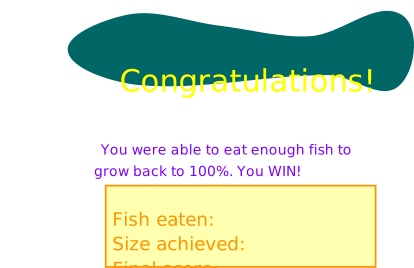
Anchovy to Blue Whale
The final score becomes a story — a cascade of if/then statements turns the player's score into a fish name they can show off.
Course path
Your game grows stage by stage
Each stage names what is new in the project and the one idea behind it.
Create the Player Fish
Set up the sprite, costumes, and sounds for the main character.
Pick a theme colorStage 2Move the Player Fish
Arrow keys move the fish using if/then in a forever loop.
Tune the speedStage 3Make the Player Fish Grow
Variables remember the fish's size and whether it is alive.
Set a smaller starting sizeStage 4Win or Lose
Broadcast handlers fire when the fish wins or gets eaten.
Pick your own celebration soundStage 5Create the Enemy Fish
Build the enemy sprite as a template that will be cloned many times.
Choose a swarm color paletteStage 6Spawn the Swarm
Use a forever loop to create a new enemy clone every couple of seconds.
Tune the spawn rateStage 7Bring the Clones to Life
Each clone picks its own random size, color, direction, and speed.
Add a rare giant enemyStage 8Eat or Be Eaten
Collision detection — smaller enemies become food, bigger ones end the game.
Add an extra score for big eatsStage 9The Stage
Backdrop, music, and a timer give the game its atmosphere.
Pick a new trackStage 10Final Score Screen
A cascading if/then turns the player's score into a fish name from Anchovy to Blue Whale.
Add a sixth categoryFor coaches
Default path first
Each stage default is enough to keep the project moving. Stretch challenges add depth when students finish early.
What is Scratch?
Scratch is a free website where you build games by snapping together colored blocks. Each block does one thing — move ten steps, play a sound, wait one second, change costume. Stack the blocks and you have a program.
Scratch was made by MIT to teach kids ages 7 and up how programs work without typing code. We use Scratch in this course because the ideas behind it (events, loops, variables, broadcasts) are the same ideas used in every programming language. Learn them here, and Python and JavaScript and Lua will feel familiar later.
Our game is called Fish Food. You play a fish. Smaller fish are food. Bigger fish are danger. Eat enough small fish without getting eaten and you win.
These are the same moving parts used by the Fish Food reference project. The course introduces them in this order so your screen only shows what you have already built.
The stages are ordered so the project grows like the book version: first the Player Fish, then enemy fish, then the ocean world, then the final score popup. If a stage preview shows the finished ocean game, it is labeled as a final target. During the build, the course only asks you to use an asset after it has been introduced.
Course time
Course Intro (30) · Setup (45) · Stage 1 (45) · Stage 2 (60) · Stages 3–9 (90 each) · Stage 10 — Final Score Screen + Demo (90) = 900 minutes, about 15 hours.
The course closes with a showcase. Plan around it.
That same material runs two ways:
- School semester — one class a week for 16 weeks. One stage per week, with catch-up, stretch, and showcase weeks built in.
- Summer camp — 3 hours a day for 5 days. Two to three stages a day, closing with a parent demo.
Coaches: the week map and the day-by-day plans are both in the Code Coach Pack.
If a stage runs long, pull time from the next stage's stretch challenges first. Stage 10 (the score screen + demo) is the only block that should never get squeezed.
Who this is for
This course is built for ages 7–9. Reading levels and language stay simple. New Scratch words get defined in a vocab card on every stage. Every stage has a short "Teacher demo" callout at the top and "Coach notes" callout at the bottom — instructors can scan those two callouts to know what to show and what to watch for.
Students do not need to know how to code beforehand. The only tool is Scratch. It runs in the browser. No installs.
The book this course is built from is Coding with Scratch by theCoderSchool. A working version of the game lives at scratch.mit.edu/projects/278144731 — you can open it any time to see what you are aiming for.